The U.S. Consumer Product Safety Commission (CPSC) continues to move full steam ahead with mandatory electronic filing (eFiling) of safety information about imported consumer products. Because this requirement will take effect on July 8, 2026, for most imports (and January 8, 2027, for foreign trade zones), pharmaceutical companies should promptly review their General Certificates of Conformity (GCC) and update them if necessary. The CPSC requires companies to maintain GCCs, which contain the data that companies will need to comply with the new eFiling requirement.
Below we explain CPSC’s enforcement role for pharmaceuticals, eFiling’s significance, how to create and update a GCC, and steps pharmaceutical companies should take now to ensure they’re not the subject of a CPSC enforcement action.
While the Food and Drug Administration (FDA) is the first agency that comes to mind for pharmaceutical regulation, CPSC also has jurisdiction over pharmaceutical products, particularly through its enforcement and administration of the Poison Prevention Packaging Act (PPPA) and the Federal Hazardous Substances Act (FHSA). The PPPA and its implementing regulations at 16 CFR part 1700 apply to orally administered prescription drugs, as well as to certain Over-the-Counter (OTC) drugs and other consumer products depending on their formulation. These drugs and other products generally must be distributed in child-resistant packaging unless an exemption applies. The FHSA requires special labeling of certain pharmaceutical products that qualify as hazardous substances.
In the past few years CPSC has announced a number of PPPA-related recalls of pharmaceuticals involving flu and cold medicine, Benadryl, prescription medications, and a variety of OTC medications. Most recently, CPSC’s Compliance office conducted a “sweep” of minoxidil products, with seven recalls between December 2025 and March 2026 because the medication was not in child-resistant packaging as required by the PPPA.
Through the Consumer Product Safety Act (CPSA), the CPSC requires the domestic manufacturer or importer to issue a GCC for any non‑children’s consumer product that must be tested for compliance under one or more safety rules CPSC enforces, including the PPPA and its regulations. For pharmaceutical companies, a GCC documents product compliance with the PPPA’s child‑resistant packaging requirements. The certificate must be based on a reasonable testing program and must be complete and accurate at the time it is eFiled. (Children’s products are subject to heightened certification requirements, but products in PPPA-compliant packaging are not children’s products.)
Although GCCs have been required at least since 2008, the eFiling Final Rule introduces a new electronic submission process designed to provide CPSC and U.S. Customs & Border Protection (CBP) with more product data at the time of import. Certificate data will have to be entered online for all import shipments subject to certificate requirements, including products subject to the PPPA.
Note that GCC requirements apply regardless of where a covered product is manufactured. The launch of the eFiling system means that imported products’ GCC information will now need to be routinely provided to CPSC and CBP. This is a major change from the current regime in which CPSC asks the importer for its GCC after targeting a particular shipment for review. In the current system, CPSC reviews GCCs for only a tiny fraction of all shipments that come into the U.S. This sea change in CPSC’s import inspection process makes it essential for pharmaceutical companies that import products with PPPA special packaging to have complete and up-to-date GCCs in place before shipment. Otherwise, if the importer’s electronic submission is incomplete or inaccurate, there is a chance CPSC will flag the shipment for review at the port of entry and possibly stop shipment into the United States.
CPSC does not prescribe any standard format or style for GCCs. Rather, the GCC simply must be in English and include seven pieces of information:
- Identification of the product covered by the certificate. For pharmaceuticals, this should include the name of the product, its dosage, and counts. The information should be specific enough to describe a single product.
- Citation to each applicable CPSC safety rule to which the product is being certified. Assuming the only CPSC rule that applies to the product is the PPPA child‑resistant packaging requirement, the citation would be “16 CFR part 1700 – Poison Prevention Packaging.”
- Identification of the domestic manufacturer or importer certifying compliance of the product. This includes the full name, address, and phone number of the importer or domestic manufacturer issuing the GCC. The manufacturer, importer, or a designated importer of record—such as a customs broker—is responsible for submitting electronically at the time of import the GCC data maintained by the manufacturer or importer.
- Contact information for the individual maintaining records of CPSC-required test results for the product. This includes the responsible person’s first and last name, address, email address, and phone number. The named individual does not have to be associated with the domestic manufacturer or importer identified in Item 3, but the firm identified in Item 3 will ultimately be responsible for ensuring CPSC can get the test reports upon request. Furthermore, delays in providing test reports to CPSC on request can delay the entry of shipments that are inspected at a port and create other problems with the agency.
- Date and place of manufacture. This information is for the finished product, not the empty packaging, and includes the date of manufacture as well as the city, state, and country in which the item was manufactured. The name of the manufacturer, whether it is the manufacturer identified in Item 3 or a contract manufacturer, does not need to be provided in Item 5. Where products are manufactured on a continuous basis, CPSC permits listing the starting month and year of manufacture for the continuous batch. However, when units are drawn from a new production run, the GCC should be updated to reflect the start date of that run. This also means that manufacturers should take care to ensure the GCC accurately reflects the applicable batch date(s) for a shipment.
- Date(s) and place(s) of testing. Similar to Item 5, this includes the date when the product was tested for compliance with an applicable safety standard, as well as the city, state, and country in which the testing occurred. There is no periodic testing requirement so long as testing unit continues to adequately represent the product being manufactured and sold. However, CPSC recommends that firms retest and recertify compliance with the PPPA’s special packaging requirements whenever there is a change in the packaging material, manufacturing process, or substance being put into the package, or if a different combination of closure and package is used. Retesting and recertification is also recommended when there are incident reports and/or complaints that suggest a compliance or manufacturing issue.
- Identification of the testing laboratory or entity that conducted the testing. This includes the full name, address, and phone number of the individual or company that conducted the testing. Although the PPPA does not require CPSC‑accredited third‑party laboratory testing, the testing records must support the certification of PPPA compliance and be readily available through the point of contact provided in Item 4.
CPSC has provided a fictional sample GCC for aspirin, contained below:
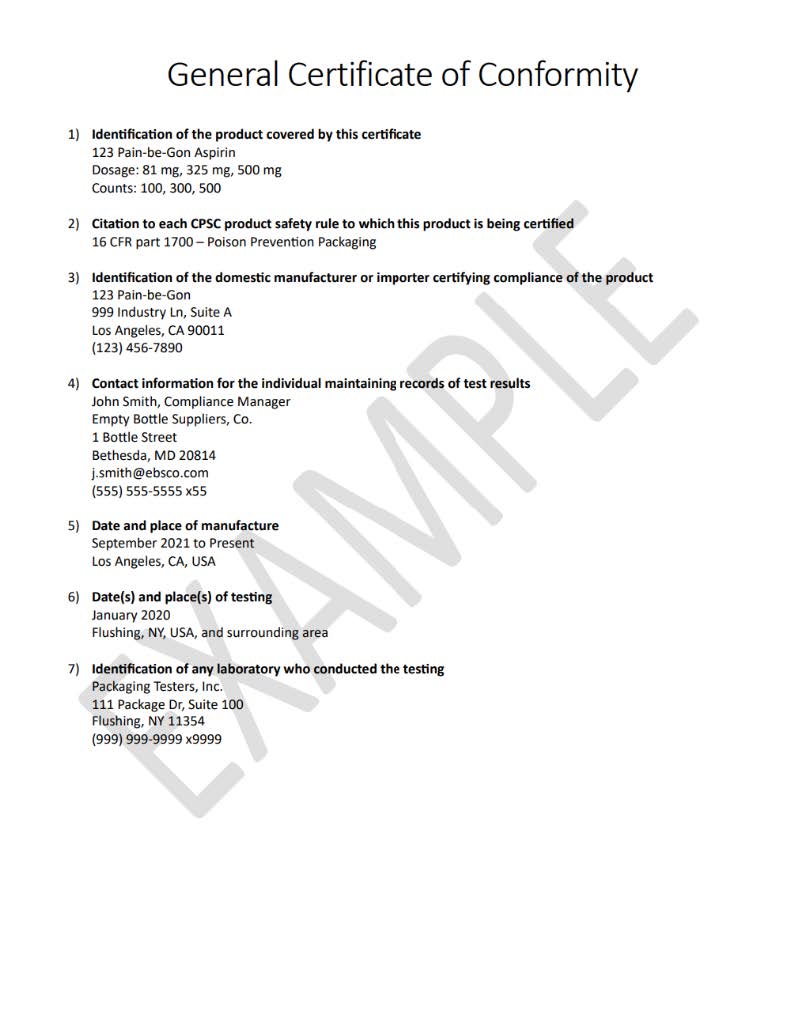
The format of the GCC is unimportant if the required information is complete and current and the GCC is readily available for use in eFiling and delivery to CPSC on request. Many companies post their GCCs on their websites, but this is entirely optional.
For decades, CPSC has required GCCs for consumer products subject to the PPPA and other CPSC safety regulations. What’s new is that, starting on July 8, 2026, the importer of record will need information from the GCC in order to complete the electronic submission to CBP that must accompany all incoming shipments of CPSC-regulated goods. Further, CPSC intends to review these submissions for shipments that, based on their Harmonized Tariff Schedule (HTS) code, are likely to be subject to a CPSC testing and certification regulation. To date, pharmaceuticals are not on the list of targeted HTS codes. But CPSC has made clear that it generally will target import shipments for which certificate data are missing, incomplete, or suggest an elevated risk of non‑compliance. If the eFiled GCC information is deficient, then the importing firm can expect electronic warnings, processing delays at the port, and possibly physical examination of and confiscation of the shipment.
With less than four months to go until CPSC’s eFiling mandate takes effect, now is a good time for companies that manufacture, import, or distribute orally administered drugs to (1) confirm the PPPA’s applicability or inapplicability to their domestic and imported products and (2) review product GCCs to ensure they are readily available and contain all the current information required in Items 1 through 7 above. Review and remediation now will be far less disruptive than addressing compliance gaps once import shipments are at the port—and it will lower the risk of CPSC enforcement action.
As highlighted in our eFiling alert earlier this year, importers may wish to participate in CPSC’s Voluntary Stage to test their readiness for eFiling, and companies that work with importers should confirm their partners’ preparedness. Businesses that import through an authorized customs broker acting as the importer of record should also determine in advance which parties the broker is authorized to designate as responsible for fulfilling CPSC testing and certification requirements.
For additional background information on the eFiling Rule and its implications, see our article, CPSC Revises Requirements for Certificates of Compliance.
If you have any questions concerning the material discussed in this client alert, please contact any of the members of our Product Safety, Investigations, and Recalls Practice Group.


 Back
Back